PKColumns

Saturday, September 5, 2009


Government of Pakistan has announced operational awards for the Armed Forces of Pakistan on the occasion of Defence Day of Pakistan 6th September 2009. Details are as follow:-

Sitara-i-Basalat  

  • Lieutenant Colonel Muhammad Tahir Iqbal (Shaheed)
  • Major Muhammad Zubair (Shaheed)
  • Major Abid Majeed Malik (Shaheed)
  • Major Syed Zahid Hussain Shah (Shaheed)
  • Lieutenant Safi Ullah (Shaheed)
  •  Havildar Naeem Asghar (Shaheed).

Tamgha-i-Basalat   

  • Captain Muhammad Tahir
  • Captain Muhammad Abid Khan (Shaheed) 
  • Lieutenant Muhammad Zeeshan (Shaheed) 
  • Naib Subedar Arshad Mahmood (Shaheed) 
  • Naib Subedar Sharif Nadir (Shaheed) 
  • Naib Subedar Himat Khan (Shaheed) 
  • Havildar Abdur Rehman (Shaheed) 
  • Havildar Muhammad Yousaf (Shaheed)
  • Havildar Mazher Rehman (Shaheed) 
  • Havildar Dewa Gul 
  • Naik Akmal Said (Shaheed) 
  • Naik Abdul Rehman (Shaheed) 
  • Naik Rehmat Ullah (Shaheed) 
  • Lance Naik Mirabat Khan (Shaheed) 
  • Lance Naik Jalil Khan,
  • Lance Naik Intizar Khan (Shaheed) 
  • Lance Naik Sarfraz Hussain (Shaheed) 
  • Lance Naik Jahangir (Shaheed)
  • Lance Naik Shadab Haider Shah (Shaheed) 
  • Sepoy Iftikhar Ahmed (Shaheed) 
  • Sepoy Ghulam Gillani (Shaheed) 
  • Sepoy Muhammad Jahangir (Shaheed)
  • Sepoy Muhammad Sajid,
  • Sepoy Muhammad Ramzan Khan (Shaheed)
  • Sepoy Arif Hussain (Shaheed).

Imtiazi Sanad

  • Colonel Mujahid Hussain 
  • Colonel Saif Ullah Orakzai 
  • Major Muhammad Farooq 
  • Major Jehangir Khan 
  • Captain Syed Ali Raza Gillani 
  • Captain Rizwan Ahmed Shaikh 
  • Subedar Major Sher Hayat Khan 
  • Havildar Abdul Rahman 
  • Lance Naik Shah Nawaz  
  • Sepoy Nasir Mahmood

COAS Commendation Card  : 

  • Colonel Naseer Ahmad Janjua
  • Lieutenant Colonel Mirza Asif Hussain Baig
  • Lieutenant Colonel Tauqir Abbas Shah
  • Lieutenant Colonel Arshad Mahmood
  • Lieutenant Colonel Abrar Hussain
  • Lieutenant Colonel Muhammad Saeed
  • Major Muhammad Ilyas Khan
  • Major Muhammad Ejaz Akhtar
  • Major Salman Jamil Noor
  • Captain Bilal Hasham
  • Captain Syed Fassih Ul Hasnain
  • Lieutenant Sami Ullah Khan Niazi.

Operation Rah-e-Rast: A Success Story


By mid May 2009, Pakistan army had launched a military action in the Malakand Division in the North West Frontier Province (NWFP) of Pakistan to hunt down militants and to eliminate their network in order to weed out the menace of terrorism prevailing inside the country for quite some time.

Within 60 days, Pakistan army has not only gunned down a number of notorious miscreants, it has also cleaned up the whole Division and started up the process of rehabilitation of over 4.5 million dislocated people that left the area before the military operation was started.

The beginning of the quick rehabilitation of dislocated people clearly illustrates the grand success of the Operation Rah-e-Rast, which has set a new example for conflict-ridden zones and where counter-insurgencies are taking place.

The Malakand Division comprises seven districts of Malakand, Swat, Bunir, Shang la, Upper Dir, Lower Dir, and Chitral. The total area of the Division is around 29,871 sq km, which is around 40 percent of the total area of NWFP and 3.7 percent of Pakistan's total land area. With a population exceeding 20,215,000, the scenic beauty, bewitching landscape and natural distinctive features of the Division makes the area a haven for domestic and foreign tourism.

The area has a high strategic significance by connecting Pakistan with the People's Republic of China on north-east, and Afghanistan on north-west by separating Pakistan from Central Asian Republic of Tajikistan through a narrow strip of 20 km at Wakhan.

In spite of the peace deal brokered between the Government and the Malakand-based so-called Tehrik-e-Nifaz-e-Shariat-e-Mohammadi (TNSM) on Feb. 16, 2009 to end insurgency engineered by Taliban and their militant followers, security situation remained unimproved.

Within 53 days, the leader of TNSM, Sufi Muhammad, unilaterally denounced the peace deal on April 9, 2009, accusing the government of not fulfilling commitment made under the deal, while government turned down all such charges as baseless.

The TNSM insisted to nominate Qazies (Sharia judges) at their own and refused to accept nominations made by the government under the Nizam-e-Adl (System of Sharia Justice) Regulations in order to lay down their weapons after the implementation of the Nizam-e-Adl Regulations. This led them to retake their arms.

First, Swat fell to them in February 2009, and later, they seized power in Bunir, Lower Dir, and Shang la districts by mid April 2009. The TNSM and Taliban chapter of the so-called Tehreek-e-Taliban Pakistan (TIP) launched militia and brutal offensives against the innocent people of the Malakand Division as well as police, government officials, security forces, Frontier Constabulary (FC), and Pakistan armed forces by challenging the writ of the State leading to chaos and ultimate brutal civil war.

They challenged the Constitution of the land and showed contempt toward principles of democracy in Pakistan. They threatened and banned media and killed reporters. They launched suicidal attacks and bomb blasts in all cities and towns in the country. They targeted intelligence agencies, several police stations, hotels and restaurants.

They kidnapped foreigners and workers of the UN and other international organizations and assassinated them. They even did not spare the invisible microscopic patriotic Sikh minority by violating the humanistic principles of Islam and other religions. They destroyed government properties, roads and bridges, and looted banks. They took over the precious emerald mines in Swat. The whole civil amenities were destroyed and vandalized.

So much so, militants' brutalities raised fears about the future of nuclear weapons of Pakistan with the apprehension of falling them into the hands of militants as generally appeared in the Western media. Within a short span of time, militants converted the Division from an idyllic tourist attraction resort into a militant fanatic sanctuary and butchery.

Ensuring order and harmony was thus the duty of the state and the government under the principles of the Holy Koran and a wide number of clauses under the 1973 Constitution of Pakistan. With widespread support from the parliament, political parties, civil society, and the masses, the Pakistan army launched the Operation Rah-e-Rast to clean up the Malakand Division from miscreants and militants, started in early May 2009.

The international community has also rendered full support to weed out terrorism inside Pakistan. The operation made significant success within days and weeks. By June 30, 2009, security forces have claimed of cleaning up of the Swat Valley, Malakand, Mingora, and Charbagh by hunting down as many as 1,635 militants, and either wounding or apprehending 254 militants, eliminating their camps and hideouts, and recovering huge caches of weapons being smuggled from Afghanistan.

During the same period, 168 Pakistani soldiers had died and another 454 were injured during the operation. The operation Rah-e-Rast has successfully dismantled the militants' network in the Malakand Division within 60 days.

The Pakistani government and the international community need to know as to how such deadly weapons and funds were being made available to militants and miscreants. An international commission should be formed to make an inquiry into this highly dangerous situation in order to prevent any such untoward eventuality in the future.

The government is in the process of devising future security and re-settlement policy in the Malakand Division. On June 12, 2009, President Asif Ali Zardari announced the establishment of military cantonment in Swat. A contingent of army will remain deployed in the Malakand Division for a year or so to re-establish law and order.

PAF using Drones in War Exercises


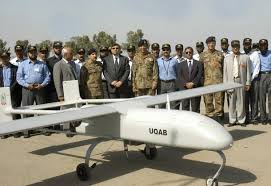
Pakistan Air Force have begun the annual war exercises, named ‘Saffron Bandit 2009-10’ to train the aviation force against extremism. 

Chief of Army Staff General Ashfaq Parvez Kayani and Chief of Air Staff Air Marshal Rao Qamar Suleman inspected the exercises.

Giving briefing about the PAF exercises at the Air Headquarters, Deputy Chief of Air Staff Air Vice Marshal Hasan said these drills are aimed at training the PAF for operation against terrorists.

The army and air chiefs were informed in the briefing that a special counter-insurgency training program was included in the exercise in wake of the current security threats to the country.

Hasan told that PAF is employing for the first time in the recent drills pilotless UAV drone planes to target the enemies, adding it was due to the precision of PAF planning that common people were not among the casualties.

They were informed that the PAF have acquired the capability to keep itself aware of any aerial movement inside the country’s airspace and can respond within three-minute time in any such case.

The top military brass was informed that a joint Pak Army-Air Force war game named as Exercise High Mark 2010 would be held next year.

Friday, September 4, 2009

Air Battle Over Lahore 20 September, 1965


Wing Comd Shafiq Chughtai gives a fascinating account of an encounter over the historic city of Lahore.

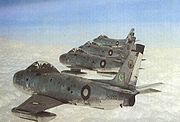
Lahore had earned itself a place of distinction the moment the war started in 1965. On the one hand it became target of enemy attacks, boasts, and propaganda claims, and on the other its citizens became both participants in, and spectators to, PakistanÕs counter-offensive in that theatre. One of the unique spectacles they witnessed, was a rare dogfight between 10 fighter aircraft right over the city. Of these, 4 were PAF Sabres, while the others were 4 Hunters and 2 Gnats of the enemy airforce. Interestingly, it was the last dogfight of the war.

It all started on the evening of 20 September, when four fighter-bombers were ordered up into the air by the air defence controller. Squadron Leader Changezi followed by Flight Lieutenant Anwar-ul-Haq Malik, Jilani and Amanullah lifted off in twoÕs and as they were still climbing, the controller came on the radio: Victor 125, Angels 20, Patrol between Kasur and Lahore. It appears that the enemy mistook this Combat Air Patrol (CAP) for an offensive mission, poised to cross the border, and it started scrambling fighters to intercept our planes over our territory. The ensuing air battle saw the loss of two enemy aircraft, and the number could have been higher, if the enemy had not broken off the engagement, and the Sabres had not been deferred by the fast approaching darkness into giving up their chase of the fleeing enemy.

Maintaining a steady climb, the Sabres set course for Kasur. They levelled off at the planned height and a few minutes later they had reached Kasur-Khemkaran sector. At 20,000 feet with the afternoon haze and glare nothing was visible down below. It was the 14th day of the war and it was long time since our ground forces had captured the important Indian town of Khemkaran, about six miles from Kasur. The fighting was now going on a few miles south of Khemkaran. The Sabres now turned about and headed for Lahore. All was quiet and peaceful, only the steady roar of engines broke the silence. Suddenly Sakesar Radar beamed a warning: ÒFour bogies climbing well inside enemy territory heading northÓ Soon the Sabres were over Lahore. They had been circling over the historic city at a lower height with eyes scanning the air above, behind and ahead, seeking to detect the approach of enemy fighters when out of the corner of his eye Amanullah caught some dark specks below. ÒTwo bandits about 5000 feet below, 11 OÕclock:Ó he yelled on the intercom. With a flick of hands the four fighters jettisoned their spare tanks to get ready for the fight. Except Amanullah, No 4 in the formation, nobody had yet sighted the enemy. On guidance by his wingman, Jilani now spotted the approaching enemy and recognized them as Hunters. The two Sabres peeled over like graceful birds of prey and slashed down, angling towards the enemy. Changezi, the leader, was on the climb when suddenly he spotted two Hunters at 12 OÕclock diving towards Jilani at about 3000 feet. Followed by Malik, who was keeping his ÔtailÕ clear, Changezi streaked down towards the two Hunters.

It was an interesting situation: Two Hunters pursued by two Sabres which in turn were followed by two Hunters, and the end of the line was made up by two Sabres again. The calm air over Lahore was filled with thud-thud of machine-guns and hissing tracers from the fighting aircraft and thousands of Lahorites, despite the air raid warning, came out of the houses to witness the show of death. The formations clashed with a high screaming reaching its crescendo as the fight developed into a melee. The sky over Lahore was a jumble of crisis-crossing, diving climbing fighters. Changezi braced his controls. With eyes fixed on the gun-sight and his spine slightly arched, he veered sharply to the left as his quarry went through a high-G turn. The silhoutte of the ÔbanditÕ had started filling his gun-sight and as it came within range he pressed the button letting out a short burst. The bullets went home and hit the fuselage of the Hunter.

The enemy wavered slightly but continued pursuit of the Sabres ahead. Changezi waited for a brief moment and fired again with the old tenacity of a pilot who feels a kill in his bones. He did a steep turn left, flicking over and then climbing all the time chasing the Hunter as if glued to his tail. The enemy tried all types of evasive tactics but could not throw away the determined Changezi. The diamonds of the gun-sight again closed on the silhoutte and he squeezed the firing button, for about two seconds. This was the end of the Indian. Giving out big plumes of smoke and flames the enemy reeled away and went straight down to his doom. The pilot could not bail out.

In the meantime ChangeziÕs Wing-man, Malik, stopped giving radio calls of Ôtail clearÕ. Changezi called him but could not hear anything. There was lot of radio talk going on between Jilani and Amanullah. He called out but again Ôno contactÕ. At that time Malik was engaged in another death struggle with two supersonic Gnat fighters which had suddenly come out of the blue and pounced upon him as he was keeping ChangeziÕs ÔtailÕ clear. One of the Gnats sneaked near him and gave a long squirt with his guns, and as the bullets landed straight into his right wing, the Sabre lurched. Surprised at this sudden turn of events Malik, who had shot down a Mystere during the historic Battle of Sargodha on September 7, now looked into his mirror and saw another of Gnat fast closing on him with leadersÕ guns blazing. The Sabre was badly hit but Malik kicked the controls and banked hard. The Gnat cut across and got his fire converging at an angle and then veering to meet his line of flight from below, giving Malik another burst, a long burst, sending the Sabre into a threat to spin. Malik brought it straight but dense fumes had started filling his cockpit. He put the aircraft in a shallow dive. Fumes had started getting worse and the controls were not answering properly. The R/T was dead and he set course for the base.

However, on the way the conditions worsened and he had to bail out. By evening he reached his base safely.

The grim dog-fight went on between three Sabres and five enemy fighters (three Hunters and two Gnats). Jilani and Amanullah maintained their chase of the two Hunters despite continuous pecking by Gnats. Amanullah was keeping JilaniÕs ÔtailÕ clear when suddenly he spotted two Gnats closing on him. He broke and after manoeuvring hard he kept himself clear of the attack. While containing the Gnats, one of the Hunters which was being chased by Jilani banked hard and manoeuvred to get behind Amanullah. He closed in and opened fire but the tracers went wide as Amanullah veered sharply to the left. The Hunter shot ahead.

In the meantime Jilani had grimly maintained his chase of the other Hunter. The enemy seemed to be a good pilot and took various evasive tactics through high Gs but Jilani kept his pursuit gradually getting nearer and nearer. His persistence paid off when the shouter of the hunter filled his gun-sight.

As it came within range he moved his finger on top of the firing button and held it down. The Sabre shuddered at the recoil of six machine-guns and a stream of armourpiercing and incendiary bullets slammed into the fuselage of the enemy. The Hunter started spitting smoke and flames as it careered down towards the ground.

Flight Lieutenant Jilani, who had mortally damaged a Gnat in an earlier combat near Ferozepur on September 13, was later awarded Tamgha-e-Basalat.

With two Hunters gone the Indians thought it better part of valour to disengage and leave for home. The three gallant fighters returned to their base safely.

India court lifts Jinnah book ban


The high court in the Indian state of Gujarat has ordered the government to lift the ban on a controversial book on Pakistan's founder Mohammed Ali Jinnah.

The book was written by Jaswant Singh, a leader in India's Hindu nationalist main opposition party, the BJP. The party subsequently expelled him.

But two social activists from Gujarat challenged the ban in court.

The state government said it had banned the book for "defamatory references" to India's first home minister.India's first home minister, Vallabhbhai Patel, is a political icon in his home state of Gujarat.

While banning the book last month, the Gujarat government had said that Mr Singh's book Jinnah: India-Partition-Independence was "objectionable, misleading and against public tranquillity".

But the Gujarat high court said on Friday that the government had not "read the book" before imposing the ban.

The court said the government had not "applied its mind" to arrive at the opinion that the book was "against national interest" and would affect public peace.
The Gujarat government is expected to issue a statement reacting to the court decision. It is not clear whether it will issue a fresh ban giving a different reasons.
Mr Singh welcomed the decision and said: "I am thrilled".

He has filed a separate case in the Supreme Court challenging the ban.
The book examines the role of Congress party leader and the country's first Prime Minister, Jawaharlal Nehru, and Mr Patel in the partition of India in 1947.

Mr Singh writes that Mr Patel was "far off the mark" in many ways with his projections about the division and future of India.

Jaswant Singh is a 71-year-old party veteran who has served as finance and external affairs minister in BJP cabinets.

Thursday, September 3, 2009

Pakistan concerned over reports of new India nuke test


Pakistan is concerned on reports that India is again preparing for a new nuclear test.
In his weekly news briefing, Foreign Office Spokesman Abdul Basit said the recent US statements on nuclear scientist Dr Abdul Qadeer and nuclear proliferation are quite baseless, adding Pakistan like any other responsible country is full-fledged alive to its responsibility.

The spokesman said there are reports that India has a new nuclear test in the works, adding these reports are rather embarrassing to Pakistan; Pakistan is however steadfast on its policy of maintaining minimum defence deterrence and does not want arms race in the region.

Responding a query regarding Mumbai investigations, the spokesman said Pakistan is serious to take those responsible to the book; while, the dossier recently delivered to Pakistan by India is same as the previous one.

Spokesman said Pakistan is opposed to the thorough physical search of Dr Afia before presenting her to the court, adding if such search is conducted, Pakistan will not condone it.

Wednesday, September 2, 2009

History of Pakistan Cricket Team


Following the Partition of India in 1947, and the establishment of the separate nation state of Pakistan, cricket in the country developed steadily and Pakistan was given Test Match status at a meeting of the Imperial Cricket Conference at Lord's Cricket Ground on July 28, 1952. The first captain of the Pakistan national cricket team was Abdul Kardar

Pakistan’s first Test match was played in Delhi in October 1952 as part of a five Test series which India won 2-1. Pakistan made their first tour of England in 1954 and drew the series 1-1 after a memorable victory at The Oval in which fast bowler Fazal Mahmood took 12 wickets. Pakistan’s first home Test match was in Dacca in January 1955 against India, after which four more Test matches were played in Bahawalpur, Lahore, Peshawar and Karachi (all five matches in the series were drawn, the first such occurrence in test history).
 
The team is considered a strong but unpredictable team. Traditionally Pakistani cricket has been filled with players of great talent but limited discipline, making them a team which could play inspirational cricket one day and then perform less than ordinarily another day. Over the years, competitions between India and Pakistan have always been emotionally charged and provide for intriguing contests, as talented teams from both sides of the border elevate their game to new levels to produce high-quality cricket. Pakistani contest with India in the Cricket World Cup have seen packed stadiums and elevated atmospheres no matter where the World Cup has been held.

The 1986 Australasia Cup, played in Sharjah, is remembered as a famous last-ball victory for Pakistan against arch-rivals India, with Javed Miandad emerging as a national hero. India batted first and set a target of 245 runs, leaving Pakistan with a required run rate of 4.92 runs per over. Javed Miandad came in to bat at number 3, and Pakistan lost wickets at regular intervals. Later recalling the match, Miandad stated that his main focus was to lose with dignity. With 31 runs needed in the last three overs, Miandad hit a string of boundaries while batting with his team's lower order, until four runs were required from the last delivery of the match. Miandad received a leg side full toss from Chetan Sharma, which he hit for six over the midwicket boundary.

At the 1992 World Cup Semi Final, having won the toss New Zealand chose to bat first and ended with a total of 262. Pakistan batted conservatively yet lost wickets at regular intervals. With the departure of Imran Khan and Saleem Malik shortly thereafter, Pakistan still required 115 runs at a rate of 7.67 per over with veteran Javed Miandad being the only known batsman remaining at the crease. A young Inzamam-ul-Haq, who had just turned 22 and was not a well-known player at the time, burst onto the international stage with a match-winning 60 off 37 balls. Once Inzamam got out, Pakistan required 36 from 30 balls, which wicketkeeper Moin Khan ended with a towering six over long off, followed by the winning boundary to midwicket. The match is seen as the emergence of Inzamam onto the international stage.

The 1992 Cricket World Cup in Australia and New Zealand marked Pakistan's first World Cup victory. It is remembered for the comeback Pakistan made after losing key players such as Waqar Younis and Saeed Anwar, and being led by an injured captain in Imran Khan. Pakistan lost 4 of their first 5 matches and were nearly eliminated in the first round of the tournament after being bowled out for 74 against England, until the match was declared as a "no result" due to rain. Captain Imran Khan famously told the team to play as "cornered tigers", after which Pakistan won five successive matches, including, most famously, the semi-final against hosts New Zealand and the final against England.

The 2007 Cricket World Cup was one of the biggest upsets in World Cup history when Pakistan was knocked out of the competition in a shock defeat to Ireland, who were playing in their first competition. Pakistan, needing to win to qualify for the next stage after losing to the West Indies in their opening match, were put into bat by Ireland on a green pitch. They lost wickets regularly and only 4 batsmen crossed double figures. In the end they were bowled out by the resurgent Irish for 132. The Irish went on to win the match, helped by a knock of 72 from Niall O'Brien. This meant that Pakistan had been knocked out during the first round for the second consecutive World Cup. Tragedy struck the team when coach Bob Woolmer died one day later on March 18, 2007 in a hospital in Kingston, Jamaica. Jamaican police spokesman, Karl Angell, reported on March 23, 2007 that, "Mr Woolmer's death was due to asphyxiation as a result of manual strangulation", and that, "Mr Woolmer's death is now being treated by the Jamaica police as a case of murder." Assistant coach Mushtaq Ahmed acted as temporary coach for the team's final group game of the tournament. Subsequent to his team's defeat and the death of Woolmer, Inzamam-ul-Haq announced his resignation as captain of the team and his retirement from one-day cricket, stating that he would continue to take part in Test cricket but not as captain. Shoaib Malik was announced as his successor. Following his return to the squad, Salman Butt was appointed as vice-captain until December 2007.

A memorial service was held in Sacred Heart Church, Lahore, for Bob Woolmer on April 1, 2007. Among the attendees were Pakistan players and dignitaries, including Inzamam-ul-Haq, who was quoted as saying, "After Woolmer's family, the Pakistan team was the most aggrieved by his death. Pakistan Qualified for Final Of T20 2009 beating SouthAfrica by 7 runs in 1st semifinal.

On April 20, 2007, a PCB official announced that former Test cricketer Talat Ali would act as interim coach, in addition to his role as team manager, until a new coach had been appointed. On July 16, 2007, Geoff Lawson, previously head coach of New South Wales, was appointed coach of the Pakistan for two years, becoming the third foreigner to take on the role.In the 2007 ICC World Twenty20, Pakistan exceeded expectations to reach the final but ended as runners-up, after losing the final to India in a nail-biting finish. On 25 October 2008, Intikhab Alam was named as a national coach of the team by the PCB.

On 21 June 2009 Pakistan won the 2009 ICC World Twenty20, beating Sri Lanka in the final by eight wickets. Pakistan had begun the tournament slowly losing two of their first three matches but after dismissing New Zealand for 99 in the Super 8 stage they had a run of four consecutive wins including beating previously unbeaten South Africa, in the semi-final, and Sri Lanka.

Tournaments:

World Cup

  * 1975: First Round
  * 1979: Semi Finals
  * 1983: Semi Finals
  * 1987: Semi Finals
  * 1992: Champions
  * 1996: Quarter Finals
  * 1999: Runners Up
  * 2003: First round
  * 2007: First round

T-20 World Cup

  * 2007: Runners Up
  * 2009: Champions


Champions Trophy

  * 1998: Quarter Finals
  * 2000: Semi Finals
  * 2002: First round
  * 2004: Semi Finals
  * 2006: First round